Two weeks: Sicily and Amalfi Coast


My favorite all time vacation was Sicily and Amalfi Coast when our kids were ages 10 and 12. It would be our family's second Italy trip. We had a great Tuscany, Venice and Rome trip a few years earlier. The kids were again adventurous and allowed for some history and churches -but always mix in the chill time and gelato or you may have a miserable situation on your hands. Southern Italy makes it really easy to keep everyone in a good mood.

If you are hoping to fly direct to Sicily, good luck. Our best flight option was to go through Frankfurt to Catania, Sicily. This gave us a bonus half day in Frankfurt. It was a fun day. We walked along the River Main and went to a great museum- the Stadel. The kids liked it, which was weird.

We had dinner in Sachesenhausen keeping it all a close walk from the hotel. Frankfurt was a nice break up of travel from Seattle to Sicily and we can all now claim Germany is on our travel list. Next morning, off to the land of my people (I'm one quarter Sicilian). Our first destination in Sicily was Taormina.

When exploring options for travel in Sicily, hiring a driver won out a couple of times over trains and rental cars, although we did a mix during this vacation. A private driver from the airport in Catania to Taormina was not very expensive and very convenient. Catania is more of a real city than a tourist site so most tourists don't linger long.
When we got to Taormina, we dropped our bags at our Airbnb, called Tao Blue.
Taormina is pretty small and our place was a short walk from all of the sites but in a quiet area with a great patio. We walked toward the Greek Theatre but stopped for some gelato.


Taormina is a picturesque kind of spot. So beautiful and perfect for half of a week. If you want to see all of Sicily and you've got 2 weeks, you could do a decent job. I wanted to see the Amalfi coast as well, so we stuck to the eastern part of Sicily. This leaves me the rest of Sicily (including my great grandfather's town of Trapani) for next time, and there will be a next time. My plan was Taormina and Siracusa would be the home bases with a few excursions mixed in.
The Greek Theatre was a few minutes walk from the Airbnb and it is the can't miss site in Taormina. The original theatre was third century BC, with the Greeks carving the seats directly from the mountain rock. Most of what we see today comes from Roman renovations in the 2nd-3rd century AD.

Of course the Romans had gladiators and animal torture instead of the Greek's plays. Fortunately, the wall behind the stage has decayed and the theatre now opens up to an incredible view of the Ionian Sea and Mount Etna (often with a little cloud of smoke for dramatic affect).

This was an awesome stop. Go early for less crowds ideally, but we did not find it too crowded in the afternoon. When you leave the theatre there are a bunch of touristy shops that we wandered through. We grabbed a couple t-shirts and some wine.

Next day was a side trip to Agrigento. This is the furthest excursion we would do in Sicily but the Valley of the Temples in Agrigento sounded too good to miss. For this trip, a group tour was the way to go as there are tours from Taormina, Catania or Siracusa.

The ride was easy and we caught a great view of isola Bella on the way (planning to hit that tomorrow). Agrigento was a wealthy ancient city founded by the Greeks in 581 BC. This city defeated the Carthaginians once but they got them in the end. Later the Romans rolled in; Saracens had a time; then the Normans. You get the point. Sicily is much stepped on.

The Valley of the Temples includes seven Doric Temples from 6-5th centuries BC. The degree to which they are preserved, especially the Temple of Concordia, is what makes this town worth visiting. The temples lie on an elevated plateau with the modern city in the back round. This first temple we got to was the Temple of Hera.

This was one of my favorites. Although more of a ruin than Concordia, it looks cool. You wander past portions of the old city walls between the temples. These walls are filled with burial niches called arcosolia.
You end up at Concordia which is one of the two best preserved Greek Temples in the world (along with the Temple of Hephaestus in Athens). It was saved by being converted into a Christian church in the 6th century.


The columns taper upward and swell in the center so that they will not appear to narrow because Ancient Greeks were aware (and worried about) human optical illusions. It is hard to describe seeing a temple that looks so well preserved.
The next temple is more on the ruin end of the spectrum.


The Temple of Olympian Zeus was built to celebrate that victory over Carthage and is the largest Doric temple ever designed. It never got finished (and mix in a few earthquakes) and now you have only a few immense columns. It originally had 25 foot tall Atlases carved into the structure but these have been removed to protect them. After this temple, we headed back to the bus which had one stop on the way back to Taormina: Villa Romana del Casale.

This villa was owned by a wealthy Roman (possibly an emperor) and it was buried in a landslide in the 12th century, under 33 feet of mud. When excavated in the 1950s, the largest collection of Roman mosaics in the world was discovered. The mudslide froze the mosaic flooring in time. The bikini girls mosaic is famous for its resemblance to ladies in modern swim wear working out.

It was a fun pit stop but not sure the kids were that impressed with mosaic preservation. The tour was only about an hour and we were back on our way to Taormina.

The next day we popped over to Isola Bella which is about a 15 minute cab ride from Taormina, but there is also a scenic cable car, followed by a short walk down to the beach.


Isola Bella is very cool little island/ beach that is second only to the Greek Theatre on to do lists for Taormina. The island is tiny and is attached to the main beach by a little sandbar that is dependent on tides. The original owners of the island built a house and imported exotic plants. The house is now a museum but I don't remember much about the interior. The island and beach are very scenic and it was good photos everywhere.

We wandered around the grounds and the kids explored and swam in the water around the island. We stayed there for a couple of hours and then got a drink and some food on the main beach before heading back to town.

When we got back up to Taormina and dumped the beach clothes, we explored town. Taormina is basically on the edge of a cliff so the views are spectacular.

We headed over to Villa Comunale di Taormina which is a small park with an old cannon and views for miles.

We explored for a while and got some lunch/ shopping done. It is very easy to see all of Taormina with our few days but everything is beautiful. I'm sure I could hang out here for a few months if you forced me. We did our usual post lunch siesta back at the Airbnb.

On the way, we stopped off at something that looked interesting. It was old theatre being excavated in a neighborhood by the main road. This odeion was a 2nd century BC theatre discovered during renovations on the adjacent church- typical Italy construction issue.

The evening plan was Castelmola. When we looked opposite the ocean from our Airbnb patio we looked up at a very steep hill with another town directly above us. This is Castelmola.

It is a medieval village on a clifftop above what already feels like a city on the edge of a cliff in Taormina. We grabbed a cab for the fun drive up the hill. It drops you in Piazza Sant' Antonio which opens out over the view down to Taormina and the sea.

Castelmola would be fun to hang out in for a weekend but we just had a couple of hours so we walked up to the Norman castle that gives the town its name. This is mostly a ruin. You go for the view, obviously. When back in the main piazza, we got dinner and a bottle of their famous almond wine for later.

This was the end of our time in Taormina. Loved it. Next morning, we did a private car to stop number two: Siracusa.

Syracuse has a modern portion that we did not spend much time in. We based ourselves on the island of Ortygia, also spelled Ortigia, which is magical. It is only a square kilometer and connects to the main city by two bridges. Most of the ancient core of Siracusa is conveniently located inside this little island.

Ortygia was founded by Greeks from Corinth in 734 BC. Many other groups have ruled and lived here, like all of Sicily. I picked our Airbnb for typical reasons: patio and location.
This place is one of my favorite all time rentals, based solely on a tiny patio that looked out on a seemingly unremarkable square and church. The church (San Francesco all'Immacolata) never seemed to be open but you felt like you could feel the Italy vibe from this perch. There was always some chatter from the restaurant below or the market across the square.


We met our host by a fabulous fountain depicting the town's central legend: Diana transforms the nymph Arethusa into a spring of water to escape another god. Syracusans will call themselves Aretusei, noting their allegiance to Arethusa. The Greek city founders were so thankful to find a freshwater spring on the edge of the ocean harbor, a legend was born. You can visit the site of this spring, but we skipped it. Syracuse was once one of the great empires of the Mediterranean, rivaling only Athens at a time.
After we met the host and dropped our bags, we headed over to the main square around Syracuse Cathedral: Piazza Duomo. It is hard to describe the colors. The whole piazza is white limestone. The churches and buildings all white or ochre, and the sky was so blue. There were minimal crowds, nothing that detracted from what was a great walk around town. We went inside the cathedral. It is impressive inside as well.
It was built directly over a 5th century BC Greek Temple of Athena. The old columns were incorporated into the structure and are visible both internally and externally.

We just wandered without a firm destination (aside from lunch). Ortygia feels like a few blocks of old Rome surrounded by walls and plopped in an ocean harbor. When wandering you will get to the edge of town pretty quickly. The southern end of the island holds Castello Maniace. Lunch was some tasty pizza a couple of blocks from our place.

Our next stop was a museum: Galleria regionale di Palazzo Bellomo di Siracusa. This is a cool spot. The museum is housed in a 12th century palace. The collection spanned from middle ages to 18th century. The kids had fun making goofy faces emulating the faces on some of these old statues.

After we spent an hour or so at the museum, we got some groceries from the market across from our place. We made dinner in the apartment and I sat out on that patio for the first of many hours over the next few days.

The next day's plan was a road trip to Noto. Noto is famous for its harmonious architecture of honey colored buildings in the Baroque style.

The harmony is largely due to the town being rebulit following an earthquake in 1693. There is one main street, Via Corso Vittorio Emanuele, which is lined with beautiful buildings, largely made out of local tufa stone, giving it the golden colors.
Trenitalia offers frequent trains from Syracuse to Noto, which takes about 30 minutes.

After checking out Noto Cathedral, we walked down to Chiesa di San Carlo al Corso. This church has a rooftop with cool bells and a pretty good view. We popped into a museum for a few minutes and then checked out the town beyond the historical main drag.

Noto was a good day trip, given how easy it was to get there and the day had a nice mixture of architecture/ churches and a little bit of shopping or food. We had a great lunch and found a t shirt shop, Siculamente, that absorbed us for a while. Several shirts were going back to Seattle.

When we got back to Siracusa, we bounced over the the beach, which in this town involves no sand. In Siracusa, beaches are much cooler, with people just sitting on huge rocks in the water outside the city walls. There are a bunch of locals sunbathing on the rocks and you can climb down into the water and take a dip. It was very fun. After the swim, we took a stroll back towards central Ortigia.

We hung close to the water and worked our way back towards Piazza Duomo. Just wandering with an eye towards some gelato, we enjoyed the Ortigia vibe. I was snapping pictures of both grand buildings and simple courtyards.


When we got back to the Syracuse Cathedral, there were two weddings going on. I imagine it is a popular spot, as that piazza just glows. The church is pretty impressive and really stands apart from its surroundings in this beautiful piazza.

The next day we were doing the historical thing, with yet another Greek Theatre. First, we walked to the Temple of Apollo on our way out of Ortigia.

The Temple of Apollo ruins are something you walk right by as you cross either bridge into Ortigia. This temple dates from the 6th century BC, making it the oldest Doric Temple in Sicily. It is next to the area where a local market exists and only takes a few minutes to check out.
Next, we grabbed a taxi for the Greek Theatre, which was one of our few times leaving Ortigia during our Siracusa stay.

The Greek Theatre in Siracusa was originally built in the 5th century BC, then rebuilt in the 3rd century BC, and had major renovations by the Romans. This it has in common with the Greek Theatre in Taormina. They do not look terribly alike. The Siracusa version is striking in the white stone which was carved directly out of the Temenite hill into which it is built.

Unlike the Taormina theatre, there is no incredible backdrop of Mount Etna or the sea, but there were hardly any crowds. It was very hot but we had a great time wandering around the theatre. There are a number of cool things in this area around the theatre.

We walked over to the Ear of Dionysius, or Orecchio of Dionisio, and also visited the altar of Heiron after the theatre.
The Altar of Heiron II is mildly interesting but is more of a ruin. What is left of this largest sacrificial altar in the Greek world, is a 600 foot long stone foundation.
The Orecchio is a limestone cave famous for its acoustic properties.
Dionysius I was the ruler of Siracusa from 432-367 BC. He used this cave as a prison.

Dionysius supposedly would hide at the top of the quarry that bears his ear's name, at a secret listening spot and eavesdrop on the prisoners. The slightest whispers from the prisoners (involving plots against him) would be magnified to the degree that he could hear them. Another legend is that he would choose this cave to torture the prisoners, as their screams would be magnified to scare the regular citizens of Siracusa into compliance with his despotism.
You could definitely appreciate the weird acoustics in the cave as we all jumped up and down and babbled like fools to hear the echo.

We headed back to Ortigia, had some lunch and then some down time on my favorite spot: the patio of our Airbnb.
The square in front of our place was known as the Piazza Francesco Corpaci. Tracy and I would have some vino and listen in on the action in the piazza.

We decided to check out another swimming spot outside the city walls. This one had an actual beach but all pebbles. There were a dozen people lounging on the shore and we took a swim. Again, we wandered back through town to our favorite piazza.

The church was not open, but we sat on the steps and had some gelato. Another successful day in Sicily. We were off to Sorrento the next day for the second half of our vacation on the Amalfi Coast. I can't wait to go back to Sicily and explore the eastern half and some of the islands off the coast that have been attracting tourists forever.

First stop on the mainland: Sorrento.
We flew from Catania to Naples and from there it is an hour train to Sorrento. Sorrento sits on the top of a modest volcanic cliff, affording a great view of the Bay of Naples. The center of town is Tasso Square, named after Renaisance poet Torquato Tasso. A few streets extend outwards from the square with fun shopping and a couple of nice museums.

The first day, we checked into our AirBnB and just wandered around town. We had lunch and did some shopping and exploring.
Our rental was right on Tasso Square. It was very fancy apartment and had the best location I could imagine in Sorrento. It was definitely loud at night, with the adjacent bar noisy until late at night.
They called the place Cuomo Charming House.

The next day we had a Pompeii adventure planned. From Sorrento, the train is about a half hour. We went with no tour and it was very easy to wander self directed. That is often the preference of the kids.


You will deal with some crowds, of course, but its easy to wander away from them in Pompeii. Initially you enter a large open area which was the forum. This part looks very different from most of Pompeii which is made of single family dwellings made of brick.
Everyone knows the history of Pompeii. Once it was conquered by the Romans in 80 BC, it became an important port of trade and a vacation spot for fancy Romans.
Unfortunately, Mount Vesiuvius' eruption wrecked the party in 79 AD. Ash and pumice covered everything, sealing things for future generations to explore.
Another area you will quickly encounter after entering is the Antiquarium. This is an enclosed area with a lot of artifacts. They have plaster casts of multiple victims of the Vesuvius eruption. There is both a small child and a dog in a twisted pose that is a little tough to look at.

Specific houses to visit include House of the Vettii and the House of the Faun. Both are impressive. There is enough open space for kids to have fun in Pompeii running around.

Their are several baths you can visit. The Forum Baths were awesome. The walls are lined with terracotta statues and a skylight offered enough light to appreciate the incredible interior.

You could wander around all day if you are interested, as the area is pretty big. Most people are targeting a few places: Roman porn frescoes, phallus symbols in the road, along with the earliest known welcome mat and beware of dog signs. We actually checked out all of the above. The spooky thing is you can always see Mt. Vesuvius sitting on the outskirts of town. Fortunately, we avoided flying ash and pumice.

After a few hours, everyone was ready to call it a day- it was a hot one, as usual for Italy in August. We headed back to Sorrento by train. We got dinner in town and chilled in our super fancy AirBnB in Tasso square.

The next day we chilled out after the busy Pompeii day. The beach is directly below your feet when you are hanging out in Sorrento.

After breakfast at Fauno Bar on Tasso Square, we walked down to Marina Piccola. This beach is located directly below the center of town. We walked down some steps along the cliff but there is also an elevator from Villa Comunale park. Like most Italian beaches, there are beach chairs to rent and it had a modest crowd.

After a dip in the ocean, we spent the day leisurely shopping in town and went into a museum: Museo Correale di Terranova. This is a quick but satisfying stop. It is a converted villa with a lovely yard around it that the kids played in for a while.
Tracy got a great leather jacket in a cute shop and everyone enjoyed a day without a heavy schedule.

The next day we checked out the Societa di Mutuo Soccorso, which is a landmark because it has been a community meeting place since the 14th century. Originally it was used by the aristocrats, but following Italy's unification it became more of a safety net organization for the working class. The frescoes remain bright and it still functions as a place locals meet and as a cafe.

We did a little shopping and then visited another green space just off the main drag: Parco di Villa Fiorentino. This has great gardens and an art collection.
Our afternoon plans were for a beach trip that would require a short bus ride. For whatever reason, we jump on every train we can in Europe but never take the bus. This destination would even be worth walking it (45 minutes on foot): The Baths of Queen Giovanna. Pick up a bus for Sorrento Capo stop and then you have a short walk.

Bagni della Regina Giovanna (the Baths of Queen Giovanna) was my favorite spot in Sorrento. We didn't even check out the 1st century BC ruins (Villa Pollio Felice) for which this is part of the landscape. The first sight was the traditional Italian beach scene: Lounging on big rocks that are in the water and jumping off those suckers.

After taking a swim in this external portion, we made our way down a cool little path to an incredible lagoon.

The water was an awesome green color and the lagoon had a arch shaped exit from the limestone cliffs that you could swim through. There were a few families enjoying the shallow, safe lagoon. We swam around this magic little spot for a while.


The last element of this great stop was cliff jumping right outside where the lagoon empties out. The height was chill enough to not be intimidating but still very fun. We all jumped a couple of times and then headed home.

We had dinner in the square (we seemed to eat most of our meals very close to Tasso Square), at O' Canonico Ristorante. This place has been around for more than a century, so it must be good. It was our good bye to Sorrento- tomorrow off to Capri for two days and one night.

The ferry from Sorrento to Capri is 15 minutes, so there is no question you should visit this famous island if you are in Sorrento for even two days. If you can spend a night, you might have some crowd free time, which is what we did.

We stayed in an AirBnB on the beach that sits next to the famous Faraglioni rocks. Once you get off the ferry in Marina Grande, everyone grabs the funicular to get up to Capri town. We grabbed a cab for our place in Marina Piccola. It is not currently available but was a great location more than making up for it being a bit rustic.

We dropped our bags and gawked at the Faraglioni for a minute (which was right outside our door) and headed out.
We started our Capri tour like a lot of people, with the view from the Gardens of Augustus. This is only 5 minutes walk from Capri Town's Piazezetta. This is a multi tiered property with incredible views of the Faraglioni and the crazy blue water of Capri.

Our next mission was to visit one the many Roman emperor haunts on Capri. This island was a hang out for many emperors but Tiberius is most linked to Capri for having twelve villas here by himself. The largest is Villa Jovis on the summit of Mount Tiberio. Tiberius made this his main home and ran the Roman empire from it from 27-37 AD.
I caught a little flack later for this visit as I might have undersold the 45 minute walk (all uphill) from town. It was 1000 degrees and tracy had one some fancy shoes, so you know...

The villa does retain a lot of brick walls and rooms but was not that memorable. The trip is mostly for the views, which are pretty incredible.

We enjoyed the downhill walk back to town and finished the day at the beach outside our place. In Homer's Odyssey, the waters outside Marina Piccola were home to the Sirens. The rocks we were swimming around once housed half woman, sailor murdering suductresses.

Homer actually included the Faraglioni, which lie a stones throw away from the Siren's rocks in his story as well. When the brave Ulysses blinded the cyclops, he threw the giant boulders from his clifftop cave at Ulysses' ships and they became the Faraglioni. Maybe Ol' Homer had a few margaritas at this beach and came up with all of his best ideas. The next day we would be getting up close and personal with those famous rocks.

I had planned on getting a group boat tour around the island, which was pretty inexpensive. While we were walking up to the tour boats, a guy approached us to see if we wanted to book a private boat. It was a little more expensive, but it was definitely worth it.

The small boat tour was the highlight of the entire two week vacation. The kids are smiling in every photo. The group tour would have been good but this was awesome. He had a little cooler with beverages and the kids could lay down on the ride.
Every boat tour starts with a stop at the blue grotto.

You have to wait outside this legendary sea cave for a smaller boat to enter the cave. The smaller boats are lined up at the entrance, which is only 3 feet high. A boatman pulls the boat through via a chain, while everyone on board has to lay down.
The color of the water is amazing and despite crowds inside and out, the Blue Grotto is worth the visit.

After we slid out the cave, we got back into our boat and left most of the crowd of boats behind. The captain did a slow tour around the island. It was a beautiful ride.

The Faraglioni are the highlight of the tour. These sea stacks are made of limestone and each has its own name: Stella, Mezzo (with the arch), and Scopolo. Scopolo, the furthest stack, is the only place that a certain blue lizard lives.

Aside from Homer's stories, another legend holds that any couple that kisses while passing under the arch of Mezzo will stay together for life. Obviously we had to lock it up while we were there.

We continued around the island and checked out a few other sea caves and smaller grottos with similar eery looking water. The captain stopped the boat at one point and we jumped out and swam around close to the coast. It was an incredible tour and the kids actually fell asleep lying on the bow of the boat on the last few minutes of the tour.

After a great two days, we had to grab another ferry to go back to the mainland. The last part of the vacation was Positano. We grabbed a ferry for the forty minute ride.

I debated whether to stay in Positano or Amalfi for this last part of the trip. Positano is one of those postcard perfect towns that bring the crowds. It was great for our few days. There are definitely too many people in the area by the beach but we didn't spend too much time there, so I loved it.

We climbed through this vertical town in a cab to get to our rental apartment.
Once we got up to the apartment, we just soaked up the view (and some vino).

The next day, I got up early and walked around to take some pictures before the town woke up.


We grabbed a bus in Positano for the forty minute ride to Amalfi. The town of Amalfi is small but was once a global power. It was founded by the Romans in the 4th century. After breaking free from Naples, it was a dominant maritime republic between the 9-12th centuries. Its glory days ended with a Norman invasion, followed by a terrible tsunami in 1343.

The Amalfi Cathedral dominates the town. It is pretty striking with its architecture drawing from Byzantine, Arab and Norman influences.

We checked out the cathedral interior. Next to the cathedral is a cloister that looks a lot like southern Spain with Moorish style. There is a cool central courtyard and interesting frescoes along the exterior. We wandered around for a few minutes and then headed out to the main street: Ruga Nova Mercatorum.
We spent a couple of hours between lunch and shopping along this street before heading back towards the port area to catch a bus.

We enjoyed our Amalfi trip but it was a pretty quick visit. Next time we come to the Amalfi Coast, I hope to spend a night or two to explore the town outside of the central core. We caught a bus back and enjoyed watching the daredevils racing vespas around the bus on the coast road back to Positano.

The spot where the bus drops you is opposite the view we got from our apartment so we took it in for a couple of minutes before walking back into town.

We wandered around the shops in Positano for a few minutes then had some dinner while some nasty weather blew through town. The rain only diminished the crowds a little. The walk up to our place was always a minor adventure.

For our last day, we were chillin' at the beach.
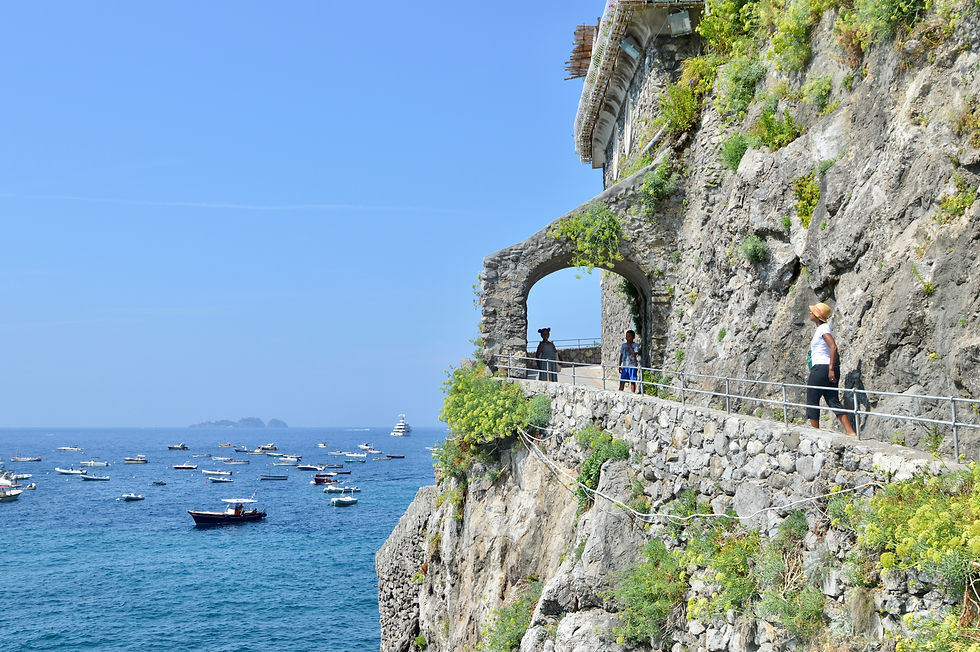
Aside from the main beach (Spiaggia Grande) we wanted to check out Fornillo Beach. The route there is a fun walking path along the coast from the main pier in Positano which takes about 10 minutes.

The kids enjoyed a chill last day. They swam at the beach and we just lounged in the sun and did very little. Everyone loved Positano and I think it was key to have a place to stay on one of the hillsides above the crowds around the main beach. Our flight back was out of Naples, so I scheduled one night there. We took another private car as it was not too expensive and very convenient.

We arrived in Naples for our last hurrah. One day was not enough to get a good feel, especially a Sunday when many things were closed. It still was a great way to go out.

Our AirBnB was in a great location next to the huge Piazza del Plebiscito. We arrived in the morning and tried a Naples classic, Gambrinus. This coffee house has hosted the rich and famous (Oscar Wilde, Ernest Hemingway, Sigmund Freud etc) and has super tasty pastries. It was one of two restaurants on our list and right around the corner from our place.

Our AirBnB had very fancy decor and a great location. https://www.airbnb.com/rooms/12378560
After breakfast and dropping our bags, we were off to the piazza around the corner.

We kept racing through the piazza as it is so huge with minimal people about early on a Sunday. The square is bound by two huge buildings: the Royal Palace of Naples and the church of San Francesco di Paola.
We wandered through the Royal Palace which had original furnishings, tapestries, paintings and statues.

We stopped by a couple of castles: Castel Nuovo and Castel dell'Ovo. Being a Sunday, we did not go inside but both were pretty cool. Castel Nuovo is imposing. It was built in 1279 for King Charles I, when Naples became a capital. The five giant towers dominate the exterior.

The Triumphal Arch between two of these towers is pretty spectacular. It was built in 1443 to commemorate Alphonso V's victory on the battlefield.

We checked out the exterior of the oldest castle in Naples, Castel dell'Ovo, which sits just off the coastline. It is a funny looking castle, also known as the egg castle due to a legend that the poet Virgil hid a magic egg in its dungeon. If the egg were to break, the city of Naples will face ruin.

Dinner time: the second restaurant on our list is the birthplace of the pizza margerita- Brandi PIzzeria. It was understandably crowded given its history but we didn't have to wait too long and the pizza was delicious.

After dinner we walked around Naples, which did have a grittier vibe than Positano, what with the armored vehicles that we were told were to combat the Camorra mafia. In some ways it was great to be in a city filled with Italians and few tourists for our last stop.
The next morning we flew out of Naples and said goodbye to a vacation we have yet to top.


Comments