Seville for 4 days

Updated: Sep 14

Our final stop on a three city tour of the south of Spain would be Seville. The train from Cordoba was only an hour. Our rental apartment was fantastic. This city packs a lot in a small walkable core. We could see the cathedral from our terrace.

After dropping our bags, we walked through beautiful Seville towards the Real Alcazar. This fortress/palace was originally built by the Moors in the 10th century with many renovations to follow, including by the conquering Christians.

The Mudejar style of the Alcazar is great and obviously reminiscent of the Alhambra in Granada. It also had great gardens and we enjoyed strolling around for an hour or two.

For lunch we did the classic: paella and sangria at Casa Robles' outdoor tables. This was in the historic old town area where we spent most of our time. Sometimes you have to wait for the paella, but its usually worth it. Overall, the family liked the food during our 2 weeks in Spain. Not Italy but not bad.

After the siesta, we walked around the area surrounding our place using a walking tour from a guide book. We started at Patio de Banderas and hit Plaza Dona Elvira and Plaza de Santa Cruz. The historical points from the guidebook were not neccessary as the Barrio Santa Cruz, the medieval Jewish Quarter, makes for a scenic stroll.

We finished our stroll back at the enormous cathedral that is the center of the action in Seville.

We had a great dinner under the shadow of the Giralda at an Italian place called Al Lado. Pizza and sangria were good. Ambiance was great.
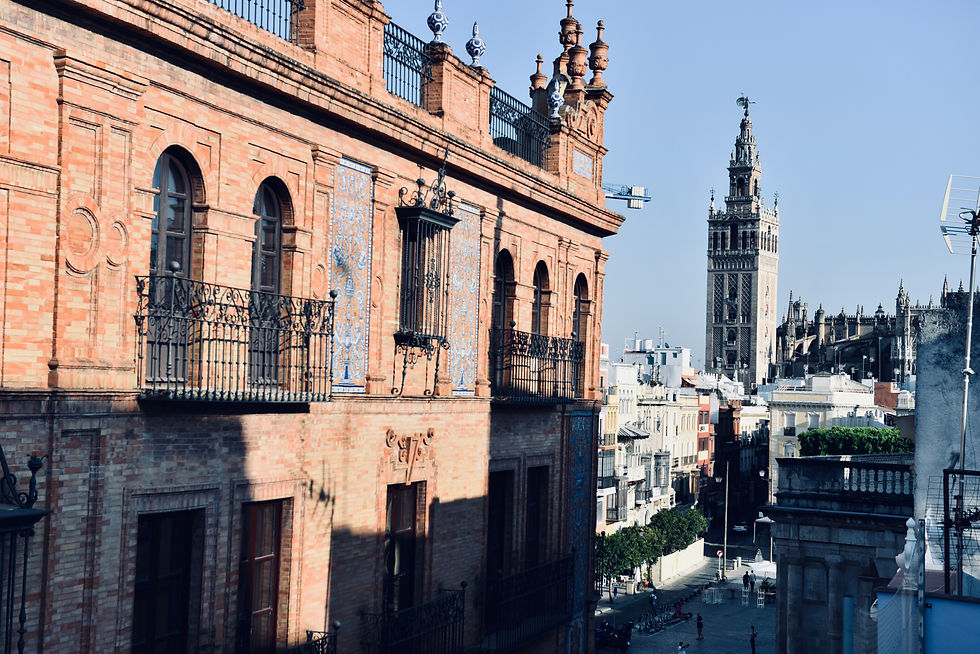
We started the next day on our apartment's rooftop patio which was pretty great. It was great spot to have a glass of wine or a coffee. You can see the Giralda, which began its life as a Moorish miniaret and was remade into a Christian bell tower.

This day we would be going to church. First, the Church of the Divine Savior, which was built on the site of a Roman church before it was a mosque during the reign of the Moors. The altar is worth a quick stop and the square this church sits on, Salvador square, has some good bars for a bite.

Next we hit the big one: Catedral de Santa Maria de la Sede (Seville Cathedral). This is the largest gothic cathedral in the world. Built on the site of an Almohad mosque (you've heard this before), the Christian reconquest was celebrated with a renovation in 1401, using the minaret of the original mosque to construct the massive Giralda bell tower.

The highlights on the interior include the Retablo Mayo, which is the largest wooden altar in Christendom. It took more than a century to finish and is covered in gold from the new world. Speaking of which, the tomb of Christopher Columbus is pretty impressive. The four statues holding his sarcophagus represent the four medieval kingdoms of Spain.

There is a lot of great art inside the cathedral, with paintings by Goya among others. We walked up the Giralda for the city views.

Most bell towers are climbed by narrow spiral staircases (done a few of those), but for this tower you climb 35 ramps which allowed the Sultan and his men climb up on horseback.

Just as in Cordoba, the church has a courtyard filled with fountains and orange trees. During Moorish times, when this cathedral was a mosque, the courtyard had innovative irrigation to allow for wudu (washing of the hands and feet before prayer). The vegetation was changed from palm trees to orange trees after the Christian Reconquista.


After church, time for some gore. Not really- I did see if there were bull fights in Spain during our trip, but they are pretty rare despite several bull rings still open. You can tour the bull ring in Seville, which also has a small museum to walk through. JT did run around as if chased and we snapped a couple of good photos.

We got lunch in Plaza de la Encarnacion next to a modernist architectural building called Setas or Metropol Parasol. It looks like just a shade structure but has elevated walkways and a rooftop but we did not go up.

We headed back to our place for the siesta and wandered by the Alcazar again. Seville is great as a city for walking about, with big squares, the massive church and a great ambiance. It never felt over crowded, and I think the temp dipped into the 90's so life was good. That night we had dinner in Plaza Nueva Square which was right outside our door.

Researching sights in southern Spain, I knew I wanted to see Ronda with its famous bridge. This led me to a white town tour like this one: https://gyg.me/AhMSCcuz .

There are a few options, but what made this tour different was the first stop known as the water castle. Castle of the Aquzaderas is a 14th century defensive structure from the battle with the Moors. Unlike nearly every other castle in Spain, this one was not built in an elevated position but in a valley to protect a natural spring in a border area between the two forces in the long conflict with the Moors. This was a very fun 30 minute diversion, which is actually free and perfect for climbing around and taking pictures.

The first of the pueblos blancos (white villages) on our tour was Zahara de la Sierra. Originally a Moorish outpost to guard the valley between Seville and Ronda.

The fortress is famous for a 1481 surprise attack from Moorish forces from Granada to retake the town. This apparently shocked the Catholic monarchs and was used as a pretext to launch the final war for Granada as a result.

The bus dropped us off in the sleepy town of white washed buildings and we climbed up to the fortress/ keep that sits above the town to take a peak at the view. The town was very quiet in the morning and it was a pretty quick stop.

Next stop on the tour was another beautiful town: Grazalema. This is a little larger town with a beautiful central square, Plaza de Espana, where the bus dropped us.

We wandered around this cute town and had lunch at a spot that has been making great food for decades: Restaurante Cadiz el Chico. Obviously, it was good. This would be a cute town to stay in for a weekend and many folks use it as a base to explore great hiking trails in the area.

Our last stop was Ronda. The tour took us to the famous bull ring, which we did not enter, then to Orson Welles' grave, and lastly to a park called Alameda del Tajo. This small park is shaded by huge trees and leads up to a view point on the edge of the el tajo gorge.

The Puente Nueve Bridge is what draws most tourists to this town. It took many years and several attempts to span the gorge that the old town was built adjacent to. The small window visible in the photo once housed a guardhouse, which later was used as a prison during the Spanish Civil War, when prisoners were reportedly thrown to their death on the rocks far below. Ernest Hemingway (who like Orson Welles, loved Ronda) wrote a scene of fascists walking a plank in For Whom the Bell Tolls, inspired by this legend.

We checked out the bridge from above and walked down to a viewpoint to get some pics from below. The town was fun for wandering and very scenic beyond the bridge and the gorge.

We had a couple of hours in Ronda, which was enough to cap a great day but obviously you could stay in Ronda a few days and explore the white villages at a more leisurely pace. When we got back to Seville after a ten hour tour we just had time for a quick bite and a glass of wine on the patio, of course.
Overall, a home run of a tour- all killer no filler. It may have been my favorite day on the two week Spanish vacation.


The next day was our last so I did not schedule too much. In the morning, Tracy and I hit Palacio de las Duenas which was a great stop. It is a 15th century home of an aristocratic family, the house of Alba. The architecture has the mash up of Mudehar (Moorish) and Renaissance styles you would expect as it was built in the same period as the Alcazar. The Duchess of Alba hosted both Jackie Kennedy and Grace Kelly in her fine digs. Classy.

The art collection and furnishings are pretty fabulous but the courtyard is the main draw- the Patio de los Limones. A famous poet, Antonio Machado was actually born here while his father worked for the family. He frequently romanticized memories of the 'lemon patio' of his youth.

We grabbed the kids and walked back toward the cathedral and the shops in the area around it.

We had a great lunch at an Italian place, Il Vesuvio, we found by wandering down a small lane. It was one of our favorite meals of the trip.

That evening we grabbed dinner again in the neighborhood around our apartment before one more glass of rioja on the patio, the Giralda all lit up in the back round.
Next day, back to Madrid before heading home.


Comments